How To Charge Devices Wirelessly Across The Room?
Traditional wireless charging still forces you to place your device on a pad or stand. That is barely “wireless” at all.
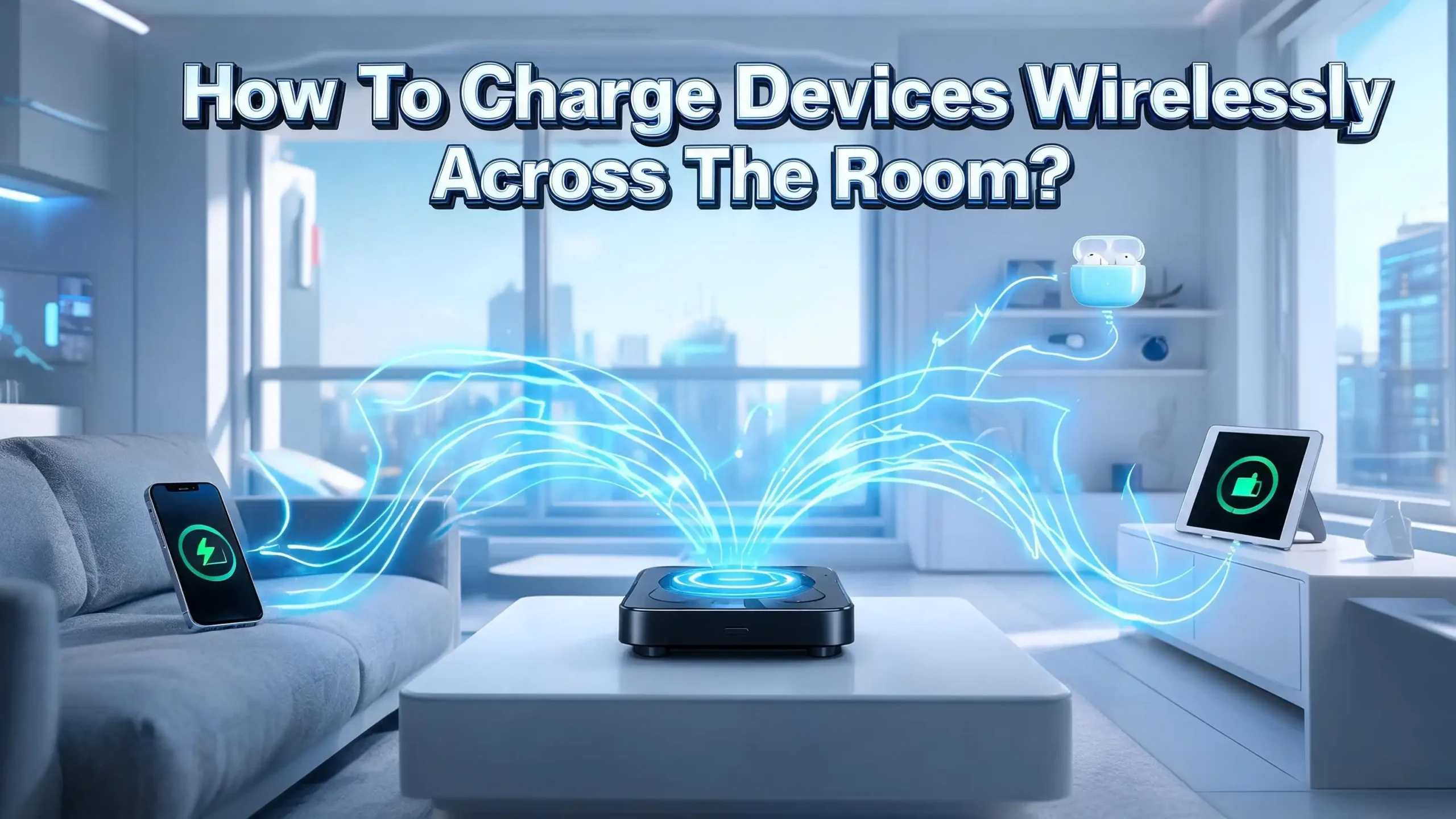
But a new wave of true wireless power technologies can beam energy across an entire room using radio frequencies, infrared light, or magnetic fields. Some of these systems are already FCC certified and being deployed in commercial settings.
This guide breaks down every method available for charging devices across a room. You will learn how each technology works, which options you can actually use today, and how to evaluate safety, efficiency, and cost.
Whether you are a tech enthusiast, a smart home builder, or just tired of tangled cables, this post gives you the practical knowledge you need to understand and prepare for room scale wireless charging.
Key Takeaways
- True wireless charging across a room is real and uses three main approaches: radio frequency (RF) based systems, infrared light beams, and magnetic resonance fields. Each method has different strengths in power delivery, range, and safety.
- RF based systems like Ossia’s Cota and Energous WattUp have received FCC certification and can charge devices at distances up to 30 feet. They send targeted power using beamforming and can work around obstacles.
- Infrared wireless charging from companies like Wi-Charge delivers several watts of power at distances over 30 feet. The technology uses focused infrared beams and is certified safe for consumer use, though it requires a clear line of sight between the transmitter and receiver.
- Research teams at the University of Michigan and University of Tokyo have built a full room that delivers up to 50 watts of wireless power through magnetic fields generated by conductive walls and a central pole. This system works regardless of device placement.
- Xiaomi’s Mi Air Charge technology uses millimeter wave beamforming to deliver 5 watts of remote charging to multiple devices simultaneously within several meters. However, it has not yet reached the consumer market.
- Safety is a primary consideration for all these technologies. FCC guidelines govern electromagnetic exposure limits, and all certified systems stay well within those boundaries. Infrared systems shut down automatically if a person blocks the beam path.
What Is Room Scale Wireless Charging
Room scale wireless charging refers to the ability to power electronic devices anywhere within a room without physical contact with a charger. This goes far beyond the Qi standard charging pads you might use today.
Standard Qi chargers use inductive coupling and require your device to sit directly on top of a pad. The gap between the charger and your device is typically less than a few centimeters. Room scale systems, by contrast, operate across distances of several feet to 30 feet or more.
These systems use a transmitter unit mounted on a wall, ceiling, or placed on a surface. The transmitter sends energy through the air using one of several methods. A receiver embedded in or attached to your device captures that energy and converts it into electricity.
The key difference is freedom of movement. With room scale wireless charging, you can hold your phone in your hand, set it on any table, or keep it in your pocket. The charging continues as long as you stay within the transmitter’s range. This creates a fundamentally different user experience from pad based wireless charging.
Several companies and research institutions are actively building and testing these systems. Some are already available for commercial and industrial applications, while others remain in the prototype or demonstration phase.
How RF Based Wireless Charging Works
Radio frequency (RF) based wireless charging sends energy through the air using radio waves. This is the same type of energy that carries your WiFi and cellular signals, but it is optimized and focused to deliver usable power to devices.
The core concept is straightforward. A transmitter generates RF signals at specific frequencies. A receiver in or on your device captures those signals using a small antenna array. A rectifier circuit then converts the RF energy into direct current (DC) electricity that can charge a battery.
What makes modern RF charging systems effective is beamforming. Instead of broadcasting power in all directions and wasting most of it, the transmitter focuses energy directly at the receiving device. Ossia’s Cota technology, for example, sends a beacon signal from the receiver to the transmitter. The transmitter then sends power back along the exact same path the beacon traveled. This “conversation” happens 100 times per second, allowing the system to track and power moving devices.
Pros of RF based systems: They can charge multiple devices at once. They work through walls and around obstacles. The receiver chips are small enough to fit inside smartphones and IoT devices. No line of sight is needed.
Cons of RF based systems: Power delivery is relatively low compared to wired charging. Efficiency drops as distance increases. The technology requires specialized hardware in both the transmitter and the receiving device. Current consumer devices do not come with built in RF power receivers.
How Infrared Wireless Charging Delivers Power
Infrared wireless charging uses focused beams of safe infrared light to transmit energy. This approach works similarly to how a solar panel converts sunlight into electricity, except the light source is an indoor transmitter instead of the sun.
Wi-Charge is the leading company in this space. Their AirCord technology uses a transmitter that plugs into standard AC power or track lighting. The transmitter converts electricity into infrared beams and sends them to a small receiver device. The receiver is about the size of a thumb and converts the infrared light back into usable electricity using a photovoltaic cell.
A research team at Sejong University in South Korea demonstrated a system using distributed laser charging that can deliver power from nearly 100 feet away. Their receiver is just 10 square millimeters, small enough to be built into almost any device or sensor.
One major advantage of infrared systems is that power delivery stays consistent regardless of distance. Unlike RF systems where power drops with the square of the distance, a focused infrared beam maintains its energy level across the room. Wi-Charge systems can deliver several watts at 30 feet or more.
Pros of infrared charging: High efficiency at long ranges. Consistent power delivery across distance. Small receiver size. Certified safe for consumer environments. No electromagnetic interference with other electronics.
Cons of infrared charging: Requires a clear line of sight between the transmitter and receiver. If a person or object blocks the beam, charging stops (though the system switches to a safe low power mode). Currently delivers enough power for IoT devices and sensors, with smartphone charging still in development.
How Magnetic Resonance Room Charging Works
Magnetic resonance is a third approach to room scale wireless charging. Researchers at the University of Michigan and University of Tokyo built a complete room that generates magnetic fields capable of powering devices anywhere inside it.
The system uses a conductive surface on the room’s walls and a conductive pole in the center of the room. These elements generate magnetic fields that resonate throughout the entire space. Devices inside the room harvest energy using small wire coils that can be integrated into electronics like phones or laptops.
The researchers demonstrated the technology in a purpose built aluminum test room measuring approximately 10 feet by 10 feet. They successfully powered lamps, fans, and cell phones that could draw current from anywhere in the room. The system delivered up to 50 watts of power without exceeding FCC guidelines for electromagnetic energy exposure.
A key innovation was the use of lumped capacitors placed in wall cavities. These components generate the room filling magnetic field while trapping potentially harmful electric fields inside the capacitors themselves. This solved a long standing safety problem with magnetic power transfer.
The system also generates two separate 3D magnetic fields. One travels in a circle around the central pole. The other moves between adjacent walls in the corners. This dual field approach eliminates dead spots, so devices can charge from any position and orientation in the room.
Pros of magnetic resonance rooms: Very high power delivery (50 watts). Works regardless of device position or orientation. Powers multiple devices simultaneously. No line of sight needed.
Cons of magnetic resonance rooms: Requires significant room modification. Currently only demonstrated in specially built test rooms. The central conductive pole may be impractical for some spaces. Commercial availability is likely years away.
Xiaomi’s Mi Air Charge Technology Explained
Xiaomi announced its Mi Air Charge Technology in 2021, creating significant excitement about the future of room scale charging. The system uses millimeter wave beamforming to deliver power wirelessly across a room.
The technology relies on a self developed charging pile that contains 144 antennas. This unit can detect the exact location of a smartphone in the room using a phase control array. Once it locates the device, it transmits millimeter wide waves through beamforming, directing energy to the precise location of the phone.
On the smartphone side, Xiaomi developed a miniature antenna array with a beacon antenna and receiving antennas. The beacon antenna broadcasts the phone’s location to the charging pile. The receiving antennas capture the millimeter wave energy and a rectifier circuit converts it into electricity.
The current capability of Mi Air Charge is 5 watts of remote charging for a single device within a radius of several meters. Multiple devices can charge simultaneously, with each receiving up to 5 watts. Xiaomi also claims that physical obstacles do not reduce the charging efficiency.
Xiaomi’s larger vision includes making entire living rooms wire free. The company wants to enable remote charging for table lamps, speakers, and all smart home products. However, as of now, the technology has not reached the consumer market. Mass production has not started, and Xiaomi has not specified which devices will support this technology or when it will be available for purchase.
Pros: Charges multiple devices at once. Works through physical obstacles. No charging pad required. Integrated antenna design fits inside smartphones.
Cons: Only 5 watts, which is slow compared to wired charging. Not available commercially yet. Requires both the charging pile and compatible devices. Real world performance is unverified.
Step By Step Guide To Setting Up Available Wireless Power Systems
If you want to start using over the air wireless charging today, your options center on commercial systems from companies like Wi-Charge and Ossia. Here is how the setup process generally works.
Step 1: Choose your use case. Determine what devices you want to power. IoT sensors, smart locks, and digital signage are the most practical applications right now. Smartphone charging is still limited in available systems.
Step 2: Select a transmitter. Wi-Charge transmitters mount on ceilings or walls and plug into standard AC power or track lighting. Ossia’s Cota transmitters can be built into various form factors. Both require professional installation for optimal performance.
Step 3: Install receivers. Each device that needs charging must have a compatible receiver. Wi-Charge receivers are about thumb sized and can be embedded into devices or attached externally. Cota receivers are silicon chips that need to be built into the device during manufacturing.
Step 4: Position the transmitter for maximum coverage. For infrared systems like Wi-Charge, ensure that the transmitter has a clear line of sight to the areas where devices will be located. For RF systems like Cota, placement near the center of the coverage area provides the best results.
Step 5: Configure the software. Both Wi-Charge and Ossia offer cloud management platforms. These tools let you monitor power delivery, check device battery status, and allocate power across multiple devices based on priority.
Step 6: Test and optimize. After installation, test charging from different locations in the room. Identify any dead spots or areas where the signal is weak and adjust transmitter positioning as needed.
Comparing Power Output Across Different Technologies
Power output is one of the most important factors to evaluate when choosing a wireless charging method. Different technologies deliver very different amounts of energy.
Magnetic resonance room systems offer the highest power at 50 watts in the University of Michigan/Tokyo demonstration. This is enough to charge a laptop or power multiple small devices simultaneously. However, this technology is not commercially available yet.
Xiaomi’s Mi Air Charge delivers 5 watts per device. This is comparable to a slow wired charger and would take several hours to fully charge a modern smartphone. Multiple devices can receive 5 watts each at the same time.
Wi-Charge infrared systems deliver several watts to each receiver at distances over 30 feet. This is sufficient to power IoT sensors, smart locks, and small displays. With continued development, the company aims to increase output to support smartphone charging.
Ossia’s Cota RF system delivers power at distances up to 30 feet, though the exact wattage varies based on distance, number of devices, and environmental factors. The system prioritizes consistent delivery over peak power.
The Sejong University infrared laser system delivers 400 milliwatts of light power, which converts to about 85 milliwatts of usable electricity. This is enough for small sensors but not yet practical for larger devices.
For context, a standard wired phone charger delivers between 5 and 25 watts, while fast chargers can push 65 watts or more. Room scale wireless charging is not yet a replacement for fast wired charging. It is best suited for maintaining charge on low power devices or slowly topping off batteries throughout the day.
Safety Considerations You Should Know About
Safety is a legitimate concern with any technology that sends energy through the air. Each wireless charging method handles safety differently.
RF based systems use non ionizing radiation at power levels similar to WiFi routers. The FCC regulates these emissions, and certified systems like Cota and WattUp stay within approved exposure limits. Ossia’s Cota technology uses a clever safety feature: the receiver initiates the power conversation, and the transmitter sends energy only along paths that avoid people and pets. This happens 100 times per second.
Infrared systems are inherently safe because the beam is invisible infrared light at levels well below any harmful threshold. Wi-Charge’s AirCord technology is certified safe for all consumer usage scenarios. If a person or object blocks the beam, the system automatically switches to a safe low power mode. Power is delivered only to the target device and does not flood the environment with energy.
Magnetic resonance systems generate magnetic fields throughout the room. The University of Michigan team used anatomical dummies to verify that their system stays within FCC guidelines for electromagnetic energy exposure at all locations. The lumped capacitor design traps electric fields (which can heat body tissue) inside the capacitors while allowing safe magnetic fields to fill the room.
Xiaomi’s millimeter wave system uses non ionizing radiation with longer wavelengths. According to the company, this does not have the energy to damage cells directly. However, since the technology is not yet available commercially, independent safety testing by regulatory bodies has not been publicly reported.
The general consensus among researchers is that all certified room scale wireless charging systems are safe for daily use within their approved operating parameters.
Current Limitations And Challenges
Despite the exciting progress, room scale wireless charging still faces several significant limitations that prevent widespread adoption.
Low power delivery is the biggest practical challenge. Most available systems deliver only a few watts at best. This is fine for IoT sensors and wearables, but it is too slow for smartphones that users expect to charge quickly. The gap between room scale wireless charging and a 65 watt fast charger is enormous.
Receiver compatibility is another major barrier. Your current phone, laptop, or tablet does not have a built in receiver for any of these technologies. You would need either new devices with integrated receivers or external adapters, which defeats some of the convenience factor.
Cost remains high for both transmitters and professional installation. These systems are currently aimed at commercial and industrial applications, not individual consumers. Retrofitting an existing room with conductive walls and a central pole for magnetic resonance charging is obviously impractical for most homes right now.
Infrastructure requirements vary by technology. Infrared systems need clear sight lines, which limits furniture placement and room layout options. Magnetic resonance rooms need specialized construction. RF systems need compatible chipsets in every device you want to charge.
Efficiency losses are real. Energy is lost during conversion from electricity to RF or infrared and back again. A wired charger delivers power with minimal loss. Room scale systems can lose 50% or more of the input energy during the transfer process, which raises questions about energy waste and environmental impact.
Standardization is still in its early stages. There is no universal standard for room scale wireless charging like the Qi standard for pad based charging. This means devices from one ecosystem may not work with transmitters from another.
What Devices Can You Charge Wirelessly Across A Room Today
The list of devices you can charge across a room today is growing, but it remains limited to specific categories and use cases.
IoT sensors and smart home devices are the primary beneficiaries of current technology. Wi-Charge has deployed its infrared power system to wirelessly charge smart locks, digital signage, and various sensors in commercial buildings. These devices consume very little power, making them ideal candidates for room scale wireless charging.
Industrial sensors and trackers in warehouses, factories, and retail environments can use both RF and infrared systems. The ability to eliminate battery changes in hundreds of sensors across a large facility offers significant cost savings and operational benefits. Wi-Charge claims each transmitter eliminates up to 5,000 batteries per year.
Electronic shelf labels and small displays in retail settings are another active deployment area. These devices need only a few watts of power and benefit greatly from being freed from wired power or disposable batteries.
Smartphones and laptops are the devices most people want to charge wirelessly, but they are not well served by today’s room scale systems. No major smartphone manufacturer currently ships a phone with a built in receiver for over the air wireless charging. The power delivery levels of most systems are also too low for practical smartphone charging.
Wearables like earbuds and smartwatches are promising candidates because of their small batteries and low power needs. However, no consumer wearable currently supports room scale wireless charging out of the box.
The path to charging your phone across the room involves both higher power transmitters and receiver chips being built into consumer electronics by major manufacturers. This transition is expected to take several more years.
How To Prepare Your Home For Future Wireless Charging
While full room scale wireless charging for consumer devices is still developing, you can take practical steps now to prepare your home for this technology.
Plan your smart home infrastructure with wireless power in mind. If you are building or renovating, consider installing track lighting on ceilings where future infrared transmitters could mount. Wi-Charge transmitters plug into track lighting, so having this infrastructure ready will make future adoption seamless.
Invest in smart home devices from companies that support wireless power. As over the air charging becomes available, manufacturers of smart locks, sensors, and displays will likely be the first to integrate receivers. Choosing devices from brands that have announced wireless power partnerships puts you in a better position.
Centralize your charging areas. Even before room scale charging arrives, you can create dedicated charging zones in your home. This habit will make the transition to true wireless charging easier, as you will already know which areas of your home are optimal for transmitter placement.
Stay informed about FCC certifications and product launches. Ossia and Energous have both received FCC approvals for their technologies. As more certifications are granted, consumer products will follow. Monitoring these developments helps you make timely purchasing decisions.
Consider your room layouts carefully. If you plan to use infrared based systems in the future, rooms with minimal obstructions between the ceiling and device locations will perform best. Open floor plans naturally suit infrared wireless power delivery. For RF based systems, room layout matters less because the signals can travel around obstacles.
Budget for gradual adoption. Room scale wireless charging will likely arrive incrementally. You might start with a few IoT sensors and eventually expand to smartphones and laptops as the technology matures and prices decrease.
The Future Of Wireless Charging Across The Room
The trajectory of room scale wireless charging points to a future where power flows as freely as WiFi does today. Several developments will drive this transformation.
Power levels will increase significantly. The 50 watt demonstration by the University of Michigan and Tokyo team proves that high power room scale delivery is physically possible. As commercial systems mature, expect power output to climb from a few watts to tens of watts over the coming years.
Receiver miniaturization will continue. The Sejong University team’s 10 square millimeter receiver shows how small these components can be. As receivers shrink and become cheaper, smartphone and laptop manufacturers will find it easier to embed them into consumer devices as a standard feature.
Industry standards will emerge. Organizations like AirFuel Alliance are developing specifications for RF wireless power. AirFuel RF is a wireless power specification that enables charging of multiple devices simultaneously within a 3D charging zone. As these standards mature, interoperability between different brands will improve.
Costs will decrease as manufacturing scales. Early adopters in commercial and industrial settings are funding the research and development that will eventually make room scale charging affordable for homes. The same cost reduction pattern occurred with WiFi, Bluetooth, and Qi wireless charging.
Hybrid approaches may combine technologies. A future smart home might use infrared beams for high power delivery to stationary devices, RF for mobile phones, and magnetic resonance in specific rooms designed for maximum charging coverage. This multi technology approach would cover all use cases while optimizing for the strengths of each method.
Researchers and engineers agree that charging your devices simply by entering a room is not a question of if, but when. The foundational technologies already exist and work. The remaining challenges are primarily about scaling, standardization, and cost reduction.
Frequently Asked Questions
Can I charge my phone across the room right now?
Not with a standard consumer smartphone. No major phone manufacturer currently ships a device with built in support for room scale wireless charging. Companies like Xiaomi have demonstrated the technology, but it has not reached the consumer market. Current systems from Wi-Charge and Ossia focus on IoT devices, smart locks, and sensors. Smartphone support will require receiver chips to be built into phones by manufacturers, which is expected to happen in the coming years.
Is wireless charging across a room safe for humans?
Yes, all FCC certified room scale wireless charging systems meet safety standards for electromagnetic exposure. RF based systems like Cota actively avoid sending power through people by updating the power path 100 times per second. Infrared systems like Wi-Charge automatically switch to a safe low power mode if a person blocks the beam. The University of Michigan magnetic resonance room was tested to confirm it stays within FCC guidelines at every location in the room.
How far can wireless power be transmitted across a room?
The distance depends on the technology. Wi-Charge infrared systems deliver power at distances over 30 feet. Ossia’s Cota RF system works at up to 30 feet. The Sejong University infrared laser system demonstrated power delivery at nearly 100 feet. Xiaomi’s Mi Air Charge works within a radius of several meters. Magnetic resonance room systems can cover the entire room, limited only by room size.
How much power can room scale wireless charging deliver?
Power output varies significantly. The University of Michigan magnetic resonance room delivers up to 50 watts. Xiaomi’s system provides 5 watts per device. Wi-Charge delivers several watts at room scale distances. The Sejong University laser system currently produces 400 milliwatts of light power. For comparison, a standard wired phone charger delivers 5 to 25 watts, so most room scale systems are slower than wired charging.
Will room scale wireless charging replace wired chargers?
Not in the near term. Current room scale systems deliver less power and are less energy efficient than wired chargers. They are best suited for keeping devices topped up throughout the day rather than providing rapid charges. Over time, as power levels increase and receiver hardware becomes standard in consumer devices, room scale wireless charging may reduce the need for wired chargers. The most likely near future scenario is that both technologies will coexist, with wireless power handling maintenance charging and wired chargers reserved for fast top ups.
What is the cost of setting up wireless charging in a room?
Current room scale wireless charging systems are primarily sold for commercial and industrial applications, and pricing is not standardized for consumers. Professional installation, transmitter hardware, and compatible receiver devices all add to the total cost. As the technology matures and production scales up, prices are expected to decrease. Early adopters should budget for higher costs comparable to the early days of WiFi or smart home technology. Contact companies like Wi-Charge or Ossia directly for current pricing on commercial installations.

Hi, I’m Amy! I’m passionate about tech and love breaking down complex product specs into simple, actionable advice. I review gadgets, compare tools, and write buying guides to help you spend smarter. Got a question? Drop me a message — I’d love to hear from you!